Xiamen Tmax Battery Equipments Limited was set up as a manufacturer in 1995, dealing with lithium battery equipments, technology, etc. We have total manufacturing facilities of around 200000 square foot and more than 230 staff. Owning a group of experie-nced engineers and staffs, we can bring you not only reliable products and technology, but also excellent services and real value you will expect and enjoy.
Atmosphere Sintering Furnace: Precision-Controlled Thermal Processing for Advanced Material Engineering
An atmosphere sintering furnace is a high-performance thermal processing system designed to sinter, densify, and thermochemically modify materials under precisely controlled atmospheric conditions. Unlike standard air-fired furnaces, an atmosphere sintering furnace allows the operator to tailor the internal environment—using inert, reducing, oxidizing, or specialized gas mixtures—to meet the stringent requirements of advanced ceramics, metal alloys, electronic materials, and powder metallurgy components. This capability makes the atmosphere sintering furnace an essential tool across industries demanding high structural integrity, chemical stability, and microstructural uniformity.
The working principle of an atmosphere sintering furnace centers on high-temperature diffusion and bonding of particles under a controlled gaseous environment. By regulating the chemical composition of the atmosphere, the furnace can suppress oxidation, promote reduction, enable carbothermal reactions, or stabilize sensitive materials. This level of atmospheric control is crucial for processing materials such as tungsten, molybdenum, stainless steel, magnetic alloys, technical ceramics, and functional electronic components.
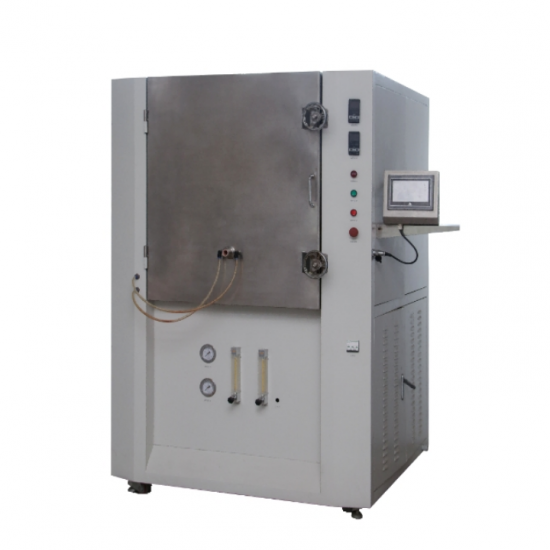
A typical atmosphere sintering furnace is composed of several key subsystems: a high-temperature sintering chamber, specialized heating elements, a multilayer insulation structure, and an advanced atmosphere control system. The furnace chamber is typically constructed from high-purity refractory materials to ensure chemical neutralization and long-term thermal stability. Heating elements may include molybdenum disilicide, silicon carbide, graphite, or tungsten, selected according to the required temperature range and atmospheric compatibility. Modern furnaces can achieve operating temperatures from 800 °C to 1800 °C depending on configuration.
The atmosphere control system is the most critical component of the atmosphere sintering furnace. It enables the introduction, regulation, and exhaust of gases such as nitrogen, argon, hydrogen, carbon monoxide, forming gases, or custom gas mixtures. Advanced models include mass flow controllers, gas purification systems, dew point monitoring, and vacuum pre-pumping stages that eliminate residual air before sintering begins. This precise environment management ensures consistent chemical reactions, reduces contaminants, and achieves accurate sintering results across different material types.
Temperature uniformity and process stability are essential for high-quality sintering. Atmosphere sintering furnaces typically feature multi-zone heating control, real-time thermocouple monitoring, and programmable thermal profiles. These allow operators to design customized heating, soaking, and cooling curves tailored to specific materials. Advanced PLC control and touchscreen interfaces provide automatic control, data logging, recipe management, and remote supervision, ensuring reproducibility in research and mass-production applications.
Applications of atmosphere sintering furnaces are diverse. In powder metallurgy, they are used for the sintering of iron-based components, carbide tools, hard alloys, and precision mechanical parts. In advanced ceramics, the furnace supports sintering of alumina, zirconia, silicon nitride, and electronic ceramic substrates under oxygen-controlled or reducing environments. The electronics industry relies heavily on atmosphere sintering for producing capacitors, sensors, ferrites, and metallized ceramic components. For high-performance metals, such as refractory alloys and magnetic materials, the controlled atmosphere is essential to prevent oxidation and promote desirable microstructural development.
Atmosphere Furnace
Energy efficiency and system reliability are key design considerations for modern atmosphere sintering furnaces. High-quality insulation materials reduce heat loss, while optimized heating systems minimize power consumption. Many furnaces incorporate rapid cooling systems or controlled cooling atmospheres to accelerate production cycles while preserving material integrity. Safety features such as gas leak detection, automatic shutdown, over-temperature protection, and sealed chamber construction ensure secure operation when using combustible or high-purity gases.
In summary, the atmosphere sintering furnace plays a crucial role in modern materials processing, offering precise temperature control, customizable atmospheric environments, and high operational reliability. Its ability to tailor sintering conditions to the exact requirements of advanced ceramic and metallic materials makes it indispensable for industries focused on high-performance components, clean processing, and consistent production quality. As materials science continues to advance, atmosphere sintering technology will remain at the forefront of engineered manufacturing solutions.