Xiamen Tmax Battery Equipments Limited was set up as a manufacturer in 1995, dealing with Laboratory equipments, technology, etc. We have total manufacturing facilities of around 2, 000 square meters and more than 100 staff. Owning a group of experie-nced engineers and staffs, we can bring you not only reliable products and technology, but also excellent services and real value you will expect and enjoy.
SEM Coater: A Professional Introduction to Precision Sample Preparation Equipment
Overview
An SEM Coater is a specialized surface coating machine designed primarily for sample preparation in scanning electron microscopy (SEM). Its main function is to deposit an ultra-thin, conductive layer onto non-conductive or poorly conductive specimens, thereby preventing surface charging and improving image resolution during SEM observation. By applying a uniform metallic or carbon coating under controlled vacuum conditions, the SEM coater plays a crucial role in ensuring accurate, high-quality microstructural and morphological analysis. Due to its reliability, ease of operation, and compatibility with a wide range of materials, the SEM coater has become an essential piece of equipment in materials science laboratories, research institutions, and industrial quality control facilities.
Key Features
Modern SEM coaters are engineered with compact structures and advanced control systems tailored for laboratory environments. A high-vacuum coating chamber is a fundamental feature, enabling clean and stable deposition with minimal contamination. Most SEM coaters support multiple coating methods, including sputter coating and carbon evaporation, to accommodate different analytical requirements.
User-friendly interfaces allow precise control over parameters such as coating current, deposition time, chamber pressure, and target selection. Many systems are equipped with automatic or semi-automatic operation modes, reducing operator variability and ensuring consistent coating quality. Additional features such as interchangeable targets, quick sample loading mechanisms, and transparent chamber windows enhance operational efficiency. Some advanced SEM coaters also include thickness monitors and programmable recipes for repeatable sample preparation.
Coating Process and Working Principle
The coating process of an SEM coater typically begins by placing the sample onto a specimen holder inside the vacuum chamber. Once the chamber is sealed, air is evacuated to achieve the required vacuum level. Depending on the coating method, an inert gas such as argon may be introduced for sputter coating, or a carbon source may be prepared for thermal evaporation.
In sputter-based SEM coaters, a high voltage is applied to the target material, ionizing the argon gas and forming a plasma. Positively charged ions bombard the target, causing atoms to be ejected and deposited uniformly onto the sample surface. For carbon coating, electrical current heats a carbon filament or rod until carbon atoms are evaporated and condensed onto the specimen. Both processes produce extremely thin and controlled coatings, typically ranging from a few nanometers to tens of nanometers in thickness, optimized for SEM analysis.
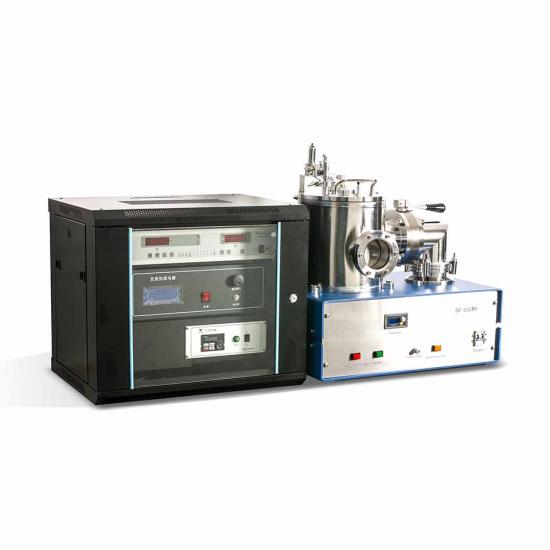
RF Sputter Coater
Applications
The SEM Coater is widely used in scientific research, industrial inspection, and educational laboratories. In materials science, it is essential for preparing ceramics, polymers, composites, and geological samples for SEM imaging. In the electronics industry, SEM coaters are used to prepare semiconductor components, printed circuit boards, and microelectronic devices for failure analysis and quality inspection.
Biological and life science applications also rely heavily on SEM coaters, particularly for imaging cells, tissues, insects, and plant structures. In forensic science and nanotechnology research, SEM coaters enable detailed surface characterization by enhancing image contrast and minimizing charging artifacts. Overall, the SEM coater is a vital tool wherever high-resolution SEM imaging is required.
Advantages
One of the key advantages of an SEM coater is its ability to significantly improve image quality by eliminating charging effects and enhancing secondary electron emission. The uniform and ultra-thin coatings produced ensure that fine surface details are preserved without obscuring microstructures.
Another major benefit is operational simplicity. SEM coaters are designed for fast setup and short coating cycles, making them ideal for high-throughput laboratory workflows. They are compatible with a wide range of coating materials such as gold, gold-palladium alloys, platinum, and carbon, offering flexibility for different analytical needs. Additionally, the controlled vacuum environment ensures repeatable and contamination-free coating results.
Conclusion
In summary, the SEM Coater is an indispensable piece of sample preparation equipment for scanning electron microscopy. With its precise coating control, versatile coating options, and user-friendly design, it ensures reliable and high-quality SEM imaging across numerous scientific and industrial applications. By enhancing image clarity and analytical accuracy, the SEM coater continues to play a critical role in modern microscopic analysis and surface characterization.